Zen candles. Zen throw pillows. Zen water filters. “Just be Zen about it.” “That room has such a Zen vibe.”
The word has been borrowed by marketers, decorators, and wellness brands for so long that most people who use it daily have no idea where it actually comes from – or what it actually means.
Here is the truth: Zen is not an aesthetic. It is a practice. And once you understand where it comes from, it becomes far more useful than any candle ever could be.
Zen is not a vibe. It is the art of letting things be exactly as they are.
Where the Word Zen Actually Comes From
Zen is the Japanese pronunciation of the Chinese word Chan, which itself comes from the Sanskrit word dhyana – a word that appears throughout the earliest Buddhist scriptures to describe meditative absorption, the stilling of the mind to see reality clearly.
This is not a side branch of Buddhism invented for aesthetic purposes. It traces directly back to the Buddha’s own teaching on meditation – the practice of training attention so completely that the usual noise of the mind quiets down and what remains is simply what is actually here.
Zen, at its root, is not a feeling you can buy. It is the direct result of a specific kind of attention.
What “Letting Things Be Exactly As They Are” Means
This phrase sounds passive. It is not. Letting things be as they are is one of the most demanding practices in the entire Buddhist tradition – because the mind’s default setting is the opposite. We are constantly editing reality: wanting it different, judging it, resisting it, improving it, escaping it.
Zen asks something harder than control. It asks for clear seeing. Not approval of everything that happens – but the willingness to first see clearly what is actually happening, before reacting to a story about it.
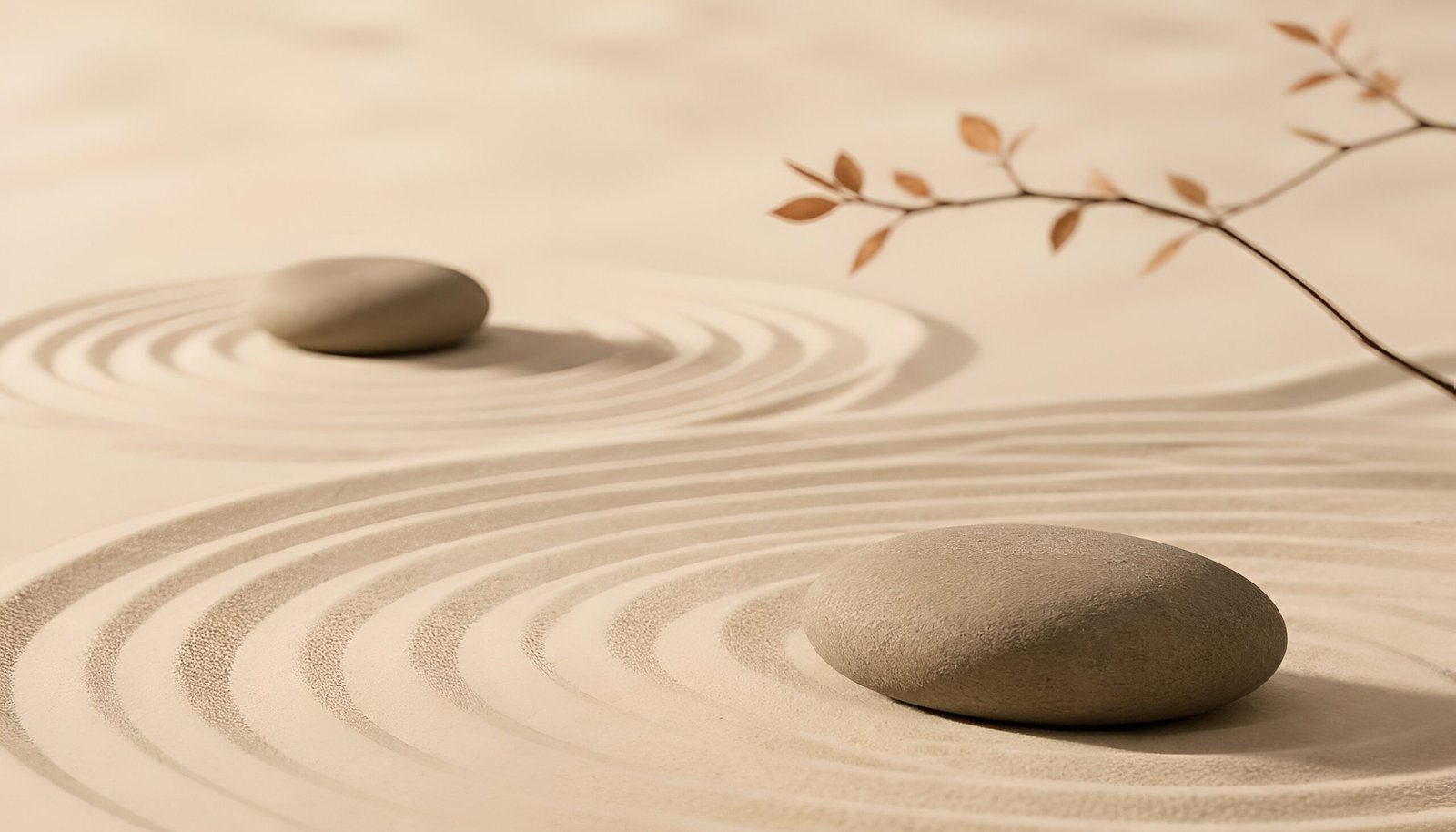
A Zen garden makes this visible. The raked sand is not chaotic, and it is not over-designed. It is simple, precise, and complete exactly as it is. Nothing needs to be added. Nothing needs to be removed. This is the visual expression of a much deeper internal practice.
The Empty Space That Is Not Empty
One of the most important concepts in Zen aesthetics is ma – the meaningful empty space. In a Zen garden, the bare sand between the stones is not unused space waiting to be filled. It is essential to the composition. It is what allows the stones to be seen clearly at all.
The same principle applies to the mind. Western culture tends to treat silence, stillness, and empty time as problems to be solved – gaps that need filling with sound, activity, or distraction. Zen treats that same emptiness as the condition that makes clarity possible.
The pause before you respond. The quiet after a thought passes. The stillness between one breath and the next. None of this is empty in the sense of meaningless. It is empty in the sense of open – holding everything that has not yet been decided.
Why Zen Became a Wellness Buzzword
Zen meditation reached the United States after the Second World War, gaining popularity through the Beat Generation and later becoming part of mainstream wellness culture. Somewhere in that journey, the depth of the practice was often left behind while the aesthetic – simplicity, minimalism, calm – was extracted and sold separately.
This is not necessarily a betrayal of the tradition. Even a shallow encounter with Zen aesthetics can point someone toward something deeper, if they choose to look further. But it does mean that most people using the word are working with a fraction of what it actually offers.
How to Practice Real Zen – Not Just the Aesthetic
- Sit in stillness, even briefly. Zen meditation does not require a special room or expensive cushion. Five minutes of sitting quietly, simply noticing the breath, is the actual practice – not a candle, not a sound, just attention.
- Notice when you are editing reality. Throughout the day, catch the moments when your mind says “this should be different.” Notice it without necessarily fixing it. That noticing is the beginning of letting things be as they are.
- Let empty moments stay empty. The next time you have a few unscheduled minutes, resist the urge to fill them immediately. Let the space be space. See what arises in it.
- Simplify one thing. Zen aesthetics did not arise from decoration – they arose from removing what was unnecessary until only what mattered remained. Apply this to one corner of your life, your space, or your schedule.
- Return to the practice, not the product. Zen was never meant to be purchased. It is available right now, without anything added – simply by sitting still and seeing clearly what is already here.
Zen is not something you decorate your life with. It is something you uncover by removing the noise that was never necessary to begin with.
If this idea of returning to stillness resonates, our guide on the Buddha’s teaching on heedfulness explores the same quality of attention from another angle.
Let things be exactly as they are. 🙏
Source: Dhyana (Sanskrit) · Chan (Chinese) · Zen (Japanese) · Buddhist meditation tradition
Tags: what zen actually means · zen buddhism explained · zen meditation origin · dhyana chan zen · zen garden meaning buddhist · zen not just aesthetic · what is zen meditation
🙏 More teachings from the Buddha
Subscribe to Peaceful Buddha for short daily teachings. Visit Peaceful Buddha on YouTube