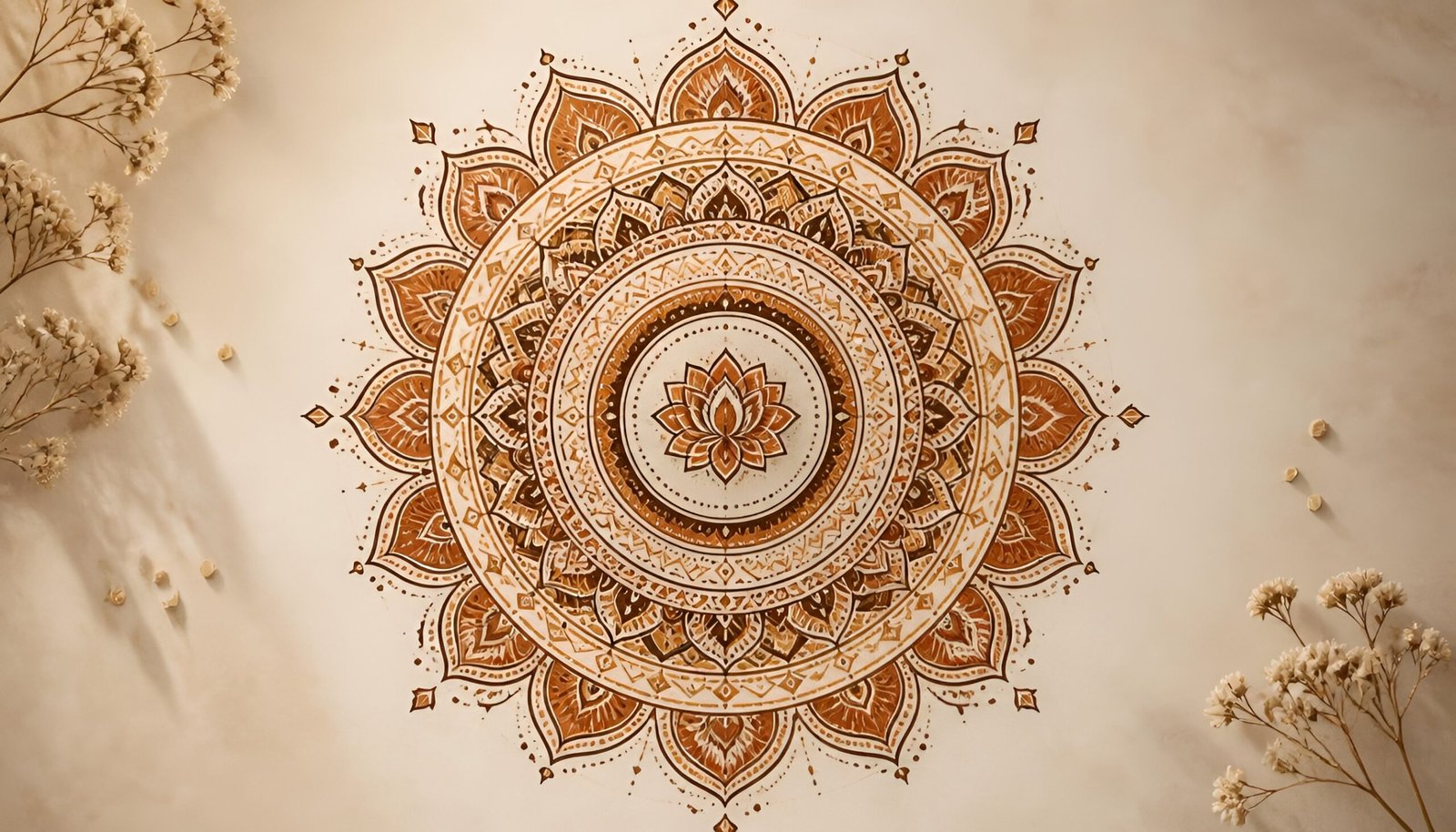
What is a mandala, really? You have seen them everywhere – on yoga studio walls, in colouring books, on phone cases and tattoos. The circular pattern radiating outward from a center, endlessly symmetric, endlessly detailed.
Most people know mandalas as beautiful images. Far fewer know what they were originally for – and why their use as a meditative practice goes back over two thousand years in Buddhist tradition.
“The mandala is a representation of the universe and the mind that perceives it – both at once.”
– Tibetan Buddhist tradition
What a Mandala Actually Is
The word mandala comes from Sanskrit – the ancient sacred language of India in which much of early Buddhist teaching was preserved. It means, simply, “circle.” But in Buddhist practice, it refers to something more specific: a sacred geometric diagram representing the universe, the mind, or a particular deity’s realm of influence.
Mandalas appear throughout Mahayana and Vajrayana Buddhist traditions – in painted thangkas, in sand mandalas created by monks over days or weeks, in architectural temple designs, and in visualisation practices used during meditation. In each context, the mandala serves as a support for the mind – a visual structure that helps attention gather and settle rather than scatter.
The Sand Mandala – Buddhism’s Most Powerful Teaching on Impermanence
Perhaps the most striking use of the mandala in Buddhist tradition is the Tibetan sand mandala – a work created by teams of monks using coloured sand, grain by grain, over days or weeks. The completed mandala can be extraordinarily intricate, covering metres of surface with geometric precision and symbolic detail.
And then, when it is finished, the monks sweep it away. The sand is gathered and poured into a nearby river or stream, releasing the blessings into the world.
This is not destruction. It is teaching. The entire practice – the weeks of careful creation, the moment of completion, the deliberate dismantling – is a living demonstration of anicca, the Buddhist teaching on impermanence. Nothing lasts. Not even the most beautiful thing you have ever made. And that is not a reason for despair. It is a reason for presence.
Why the Practice Quiets the Mind
The meditative effect of mandala drawing is not incidental. It arises from the specific quality of attention the practice requires.
When you draw symmetrically from a center, the mind has something real to track – a line, a pattern, a relationship between one mark and the next. It is not passive enough to wander into worry, and not demanding enough to produce strain. It occupies the part of the mind that otherwise generates papanca – mental proliferation, the restless chatter that the Buddha identified as a primary source of unnecessary suffering.
What remains, when that chatter is gently occupied, is a quieter layer of awareness – the same layer that formal meditation trains, arriving through a different door. Many people who find sitting meditation difficult discover that mandala drawing produces a similar stillness, more naturally, through the hands rather than through effort.
What Each Symbol Means
Traditional Buddhist mandalas are not random patterns. Each element carries meaning drawn from centuries of contemplative tradition.
The center point – the bindu – represents the origin, the undivided source from which all experience arises. In meditation, it is the point of attention itself.
The concentric circles moving outward represent layers of existence – from the innermost awakened mind to the outermost realm of ordinary experience. Moving inward through the circles during meditation is understood as moving toward clarity and away from confusion.
The symmetry – which is the mandala’s most immediately recognizable quality – reflects the Buddhist understanding of balance: that reality, when seen clearly, has an underlying order that the agitated mind obscures.
The lotus motif that appears in so many mandalas represents what the Dhammapada teaches directly: that beauty and wisdom arise from difficulty, not despite it – the lotus that blooms in muddy water.
How to Begin Your Own Mandala Practice
You do not need artistic skill. The mandala tradition was never about producing technically perfect images – it was about the quality of attention brought to the making. A child’s mandala, drawn slowly and with genuine presence, carries the same meditative value as one produced by a trained artist.
The simplest approach: begin at a center point, and move outward in any direction, keeping the symmetry as you go. Let the pattern emerge from the movement of your hand rather than from a plan in your head. Notice when the mind wanders. Return to the line. This is the same instruction as breath meditation – just through a different medium.
If you would like to try mandala drawing on your phone or tablet, a simple app called 꽃피움 (Kkotpium) allows you to draw mandalas with touch gestures, with automatic symmetry built in – so the pattern completes itself as you draw, with no artistic skill required. It is a quiet way to spend ten minutes at the end of a day.
🌸 Try Mandala Drawing on Your Phone
꽃피움 (Kkotpium) – a free mandala drawing app.
Touch once. A mandala blooms. Download on Google Play →
The mandala has been used as a tool for stillness for over two thousand years. The monks who sweep away their sand mandalas are not wasting their work. They are demonstrating, one more time, that the practice was never about the product. It was always about the quality of mind that the making cultivated.
If quieting mental chatter through presence resonates, our guide on the Buddha’s teaching on heedfulness explores the same territory from a different angle.
Draw slowly. Let your mind settle. Watch something bloom. 🙏
Source: Mandala tradition · Anicca (impermanence) · Papanca (mental proliferation) · Vajrayana and Mahayana Buddhist practice · Pali Canon
Tags: what is a mandala buddhism · mandala meditation buddhist · sand mandala impermanence · why draw mandalas mindfulness · mandala drawing calm mind · tibetan mandala practice · kkotpium mandala app
🙏 More teachings from the Buddha
Subscribe to Peaceful Buddha for short daily teachings. Visit Peaceful Buddha on YouTube