If you can’t sleep at night no matter how tired you are, this is for you. It is 2am. You are exhausted. And your mind will not stop.
A conversation from last week. A decision you have not made yet. A worry without a name that sits in your chest and refuses to leave. The thoughts are not linear – they loop. What if this doesn’t get better? What if I can’t fix it? What if this is just how things are now?
The Buddha had a name for this. And more importantly, he had a way through it.
“Do not pursue the past. Do not lose yourself in the future. The past no longer is. The future has not yet come. Looking deeply at life as it is in the very here and now, the practitioner dwells in stability and freedom.”
– Buddha, Bhaddekaratta Sutta (MN 131, Pali Canon)
Why You Can’t Sleep at Night – The Buddhist Explanation
In Buddhist psychology, the inability to sleep is not a malfunction of the body. It is a symptom of the mind in a state the Buddha called uddhacca – restlessness, agitation, the mind that cannot find stillness because it has spent all day grasping.
During the day, the mind has constant input to grab onto – work, conversations, screens, decisions, distractions. This grasping becomes a habit. A high-speed default. Then night comes. The body needs to shut down. But the mind does not know how to stop reaching. So it turns inward and grabs the only things left – worries, regrets, and imagined futures.
The problem is not the thoughts themselves. The problem is the mind’s habit of clinging to them. And that habit, the Buddha taught, can be trained.
The Buddha’s Own Sleep Posture – The Lion’s Pose
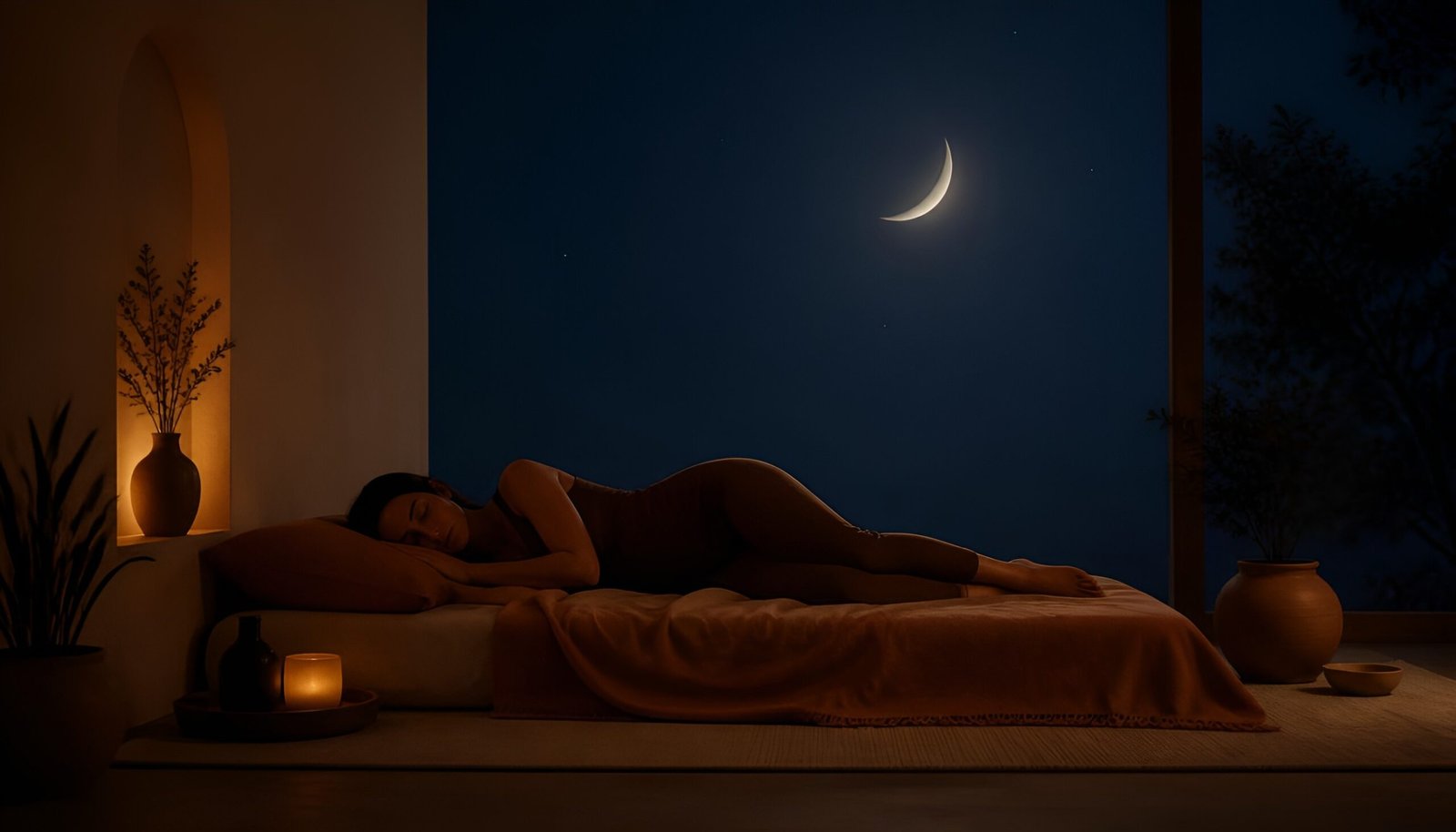
The Buddha entered nirvana lying on his right side – knees slightly bent, right hand beneath his cheek, left hand resting on his left thigh. This posture, known as the Lion’s Pose or sihaseyya, has been used by Buddhist practitioners for over 2,500 years as a posture for sleep.
Lying on your back invites drowsiness and disturbed sleep. Lying face-down compresses the chest and increases anxiety. The Lion’s Pose keeps the body in what the Buddha called the middle way – relaxed but not collapsed, settled but not tense. It creates the physical conditions that allow the mind to follow.
Try it tonight. Right side. Knees gently bent. Right hand beneath your cheek. Left hand resting softly on your leg. Breathe slowly and let the body settle before you ask the mind to follow.
“Sleep is the best meditation.”
– Dalai Lama
Anapanasati – The Buddha’s Breath Practice for When You Can’t Sleep at Night
The Buddha taught a practice called Anapanasati – mindfulness of breathing. For sleep, it works like this: count your breaths from one to ten, then begin again. If your mind wanders, start over at one.
This is more effective than counting sheep because it has no associations. “Sheep” triggers images – fields, farms, movement. One thought pulls out the next and the mind accelerates. A number is neutral. It gives the grasping mind something to hold that leads nowhere – and that nowhere is exactly where sleep lives.
The goal is not to reach ten. The goal is to keep returning to one. Each return loosens the mind’s grip on everything it was holding.
What to Do When You Can’t Sleep at Night and Thoughts Won’t Stop
- Do not fight the thoughts. Fighting a thought gives it energy. Watch it arise without grabbing it or pushing it away. “There is a thought about tomorrow.” Name it and let it pass like a cloud moving across a dark sky.
- Return to the body. Anxiety lives in the future. The body lives now. Feel the weight of your body on the bed. Feel the temperature of the air. Feel the rise and fall of your chest. The body is always in the present moment – and the present moment is the only place sleep can happen.
- Use the Lion’s Pose. Right side. Knees gently bent. Slow breath. Let the posture signal to the nervous system that it is safe to rest.
- Count breaths, not worries. One breath in, one breath out – that is one. When the mind wanders, begin again at one. Without frustration. Without judgment. Simply one.
- Remember impermanence. Whatever the mind is circling at 2am – the problem that feels unsolvable, the fear that feels permanent – this thought is not permanent. This feeling is not permanent. This night will end. It always does.
Sleep as a Small Act of Letting Go
Falling asleep is a small act of surrender. Each night, you temporarily release the self – the you with its identity, its worries, its responsibilities, its story. You let go, for a few hours, of being anyone at all.
For a mind trained in grasping, this is the most difficult thing. It requires trusting that the world will continue without your vigilance, that the problem will still be there to solve in the morning, that you are allowed to stop, even briefly, even just for tonight.
You prepare the conditions – the posture, the breath, the letting go – and then you stop trying. Sleep, like insight, cannot be forced. It can only be welcomed.
If you can’t sleep at night again tomorrow, the same practice is waiting – it doesn’t need to work perfectly the first time to be worth returning to.
Rest is not a reward. It is a practice. 🙏
If it’s the anxious loop itself that’s the harder part to release, even outside of bedtime, our piece on Buddhist teaching on anxiety goes deeper into working with that pattern.
Source: Uddhacca (restlessness) · Anapanasati Sutta · Sihaseyya (Lion’s Pose) · Bhaddekaratta Sutta · Pali Canon
Tags: cant sleep at night, how to fall asleep fast, buddhist technique for sleep, restless mind at night, anapanasati sleep, lions pose buddha sleep, insomnia buddhist teaching
🙏 More teachings from the Buddha
Subscribe to Peaceful Buddha for short daily teachings. Visit Peaceful Buddha on YouTube