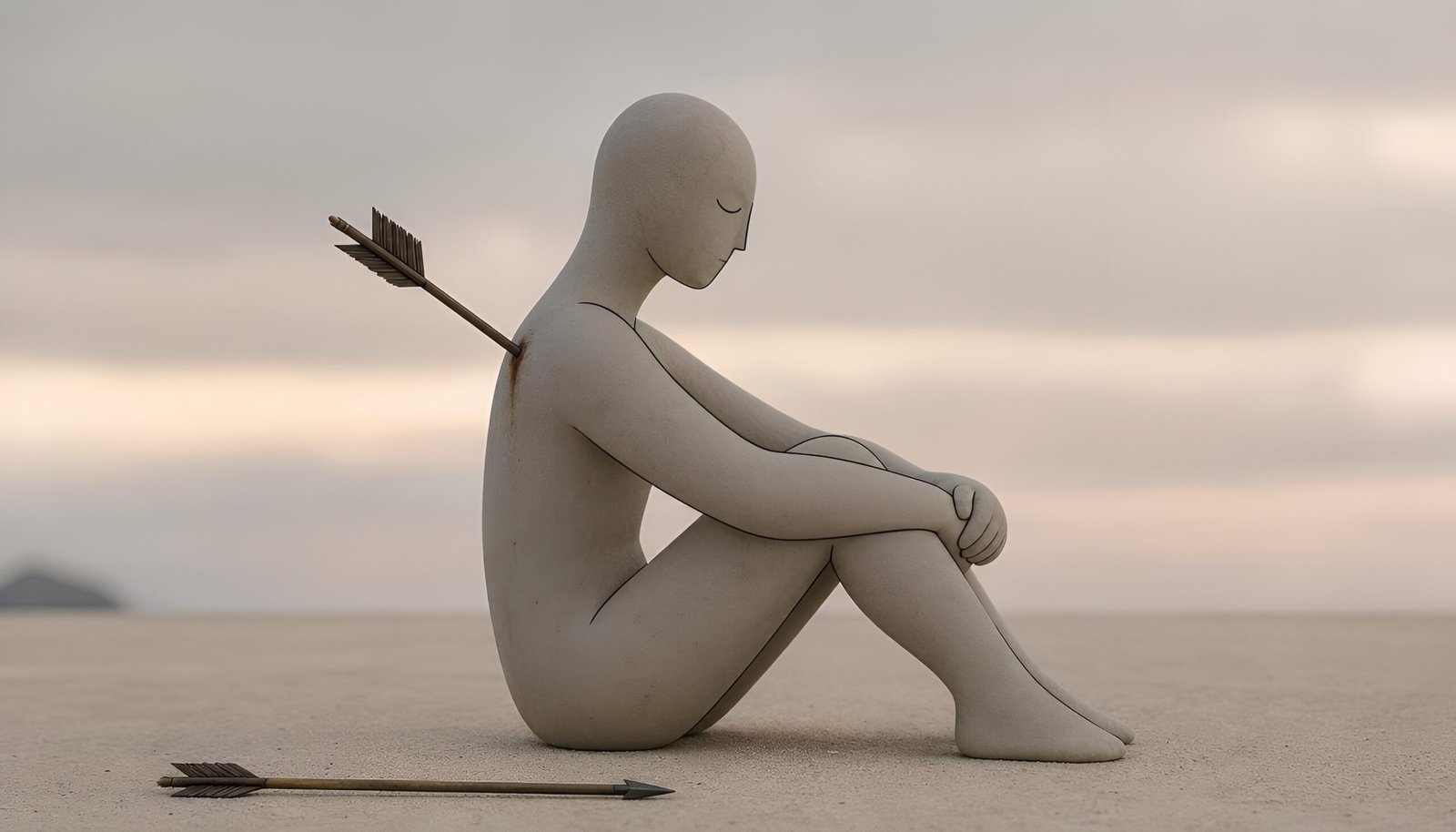
Buddha teaching on chronic pain starts from a question a student once asked him directly: does an awakened person still feel physical pain. Buddha said yes, without hesitation. What changes isn’t the pain itself. What changes is everything that gets added on top of it.
Buddha answered with a parable that’s stayed remarkably intact for over two thousand years, known today as the teaching of the two arrows.
Buddha Teaching on Chronic Pain: The First Arrow You Didn’t Choose
The first arrow is the raw sensation itself: the ache, the injury, the flare-up. This teaching doesn’t pretend the first arrow can be argued away or meditated out of existence. An ordinary person and an awakened person get struck by the exact same first arrow. Pain is pain. Nothing here asks you to deny that, minimize it, or pretend it hurts less than it does.
The Second Arrow: The One You Fire Yourself
Here’s where the teaching turns. An untrained mind, struck by the first arrow, typically fires a second one right after it: the frustration, the fear of it never ending, the resentment at the body for failing, the mental replay of every time this same pain has shown up before. Buddha called this the second arrow, and a very specific sense makes it self-inflicted. Nobody outside you shoots it. The mind fires it automatically, layered directly on top of the pain that was already there.
Two arrows, two different wounds, but only one of them was unavoidable.
Why Chronic Pain Makes This Distinction Matter
Chronic pain is where this teaching stops being philosophical and starts being practical. Someone living with pain that doesn’t resolve isn’t getting hit once. They’re getting hit by the first arrow repeatedly, sometimes daily, sometimes constantly. The total suffering compounds far beyond what the physical sensation alone would produce, if every one of those hits also triggers a full second arrow – the dread, the catastrophizing, the anger at their own body. Pain researchers generally treat this psychological layer as a major factor in disability and suffering, separate from raw pain intensity.
What Practicing This Teaching on Chronic Pain Looks Like
This isn’t a technique for eliminating the second arrow through willpower in one sitting. It’s a much slower practice of noticing the gap between the two arrows as it happens – catching the moment where raw sensation turns into a story about the sensation, and just seeing that turn happen. Seeing it clearly enough, often enough, loosens its automatic grip over time. The pain doesn’t necessarily shrink. The story wrapped around it does.
This connects to the earlier teaching on grief, which works with a similar structure – an unavoidable first loss, and a second layer of suffering built from resisting that the loss happened at all. For the full original text, SuttaCentral’s translation of the Sallatha Sutta lays out the parable in Buddha’s own words.
Next time pain shows up, try naming which arrow you’re actually reacting to in that moment. Sometimes just asking the question is enough to loosen the second one’s grip.
Source: Sallatha Sutta (The Arrow), Samyutta Nikaya 36.6 · Pali Canon
Tags: buddha teaching on chronic pain, two arrows sutta explained, buddhism and physical suffering