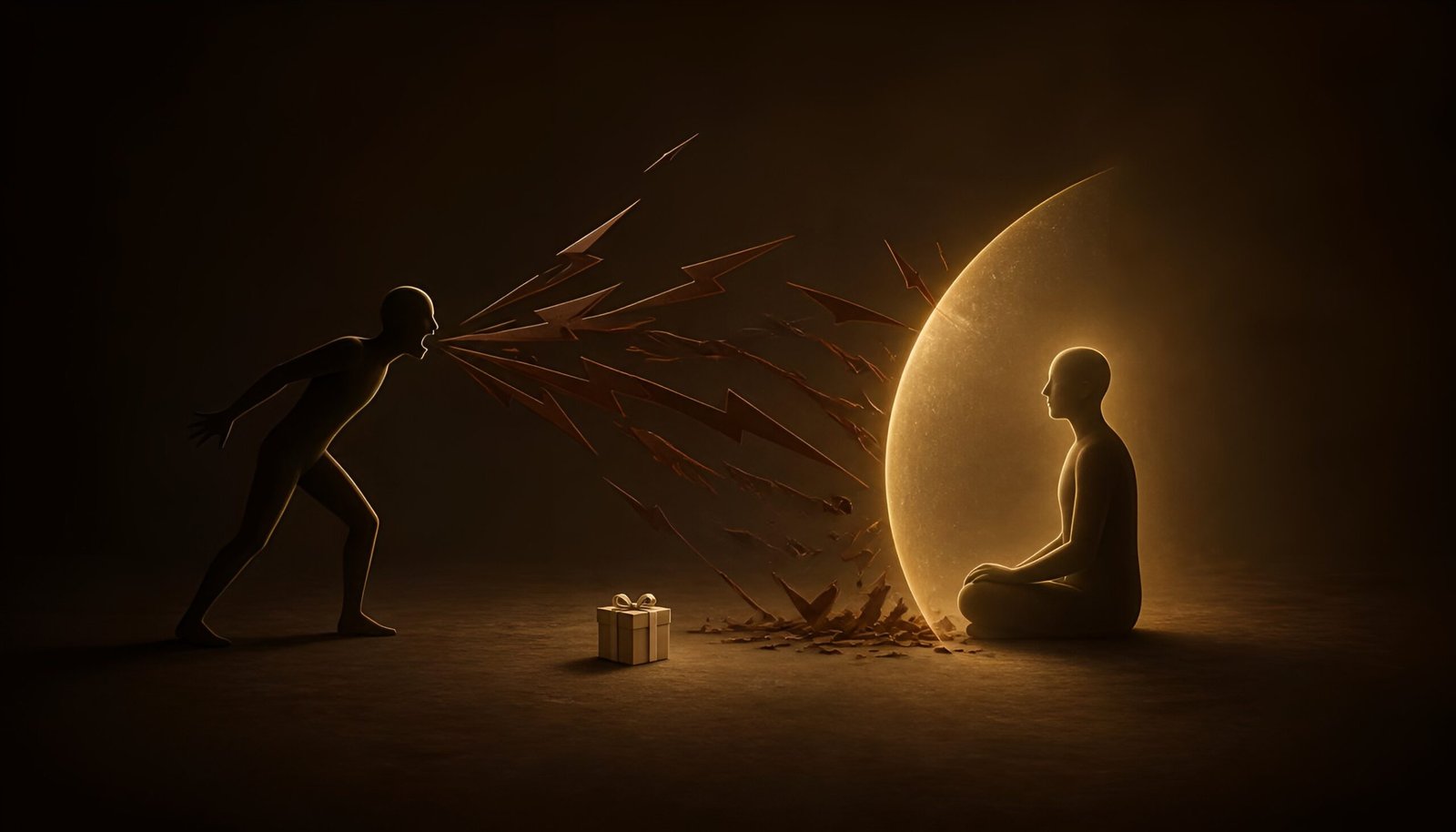
Don’t accept their anger, that’s the entire lesson in what happened next. A man walked up to the Buddha and began cursing him. For five full minutes, he hurled insults, rage, contempt, everything he had.
The Buddha said nothing. He simply waited.
When the man finally finished, exhausted by his own anger, the Buddha asked him one quiet question, and it changed everything.
“If you offer a gift to someone and they refuse to accept it, to whom does the gift belong?”
– Buddha, Samyutta Nikaya (Akkosa Sutta)
The man paused. “It would belong to me,” he said. “I would take it back.”
The Buddha nodded. “Then I do not accept your anger. It remains yours.”
The True Story from the Samyutta Nikaya
This exchange comes directly from the Akkosa Sutta in the Samyutta Nikaya, one of the oldest collections of Buddhist scripture in the Pali Canon. The man in the story was a brahmin named Akkosaka Bharadvaja, “Akkosaka” meaning “the abusive one,” a name he earned through this very encounter. He had heard that a relative of his clan had become a monk under the Buddha and came to confront the Buddha directly.
What makes the Buddha’s response so remarkable is not that he ignored the anger. He acknowledged it entirely, and then simply declined to receive it. He treated the man’s rage like a package left at the door. You can leave it there. I am not opening it.
Why You Shouldn’t Accept Their Anger
Most of us were never taught this. When someone directs anger at us, we absorb it, we defend ourselves, explain ourselves, or carry their mood home with us for the rest of the day.
But the Buddha’s teaching here is precise: anger only lands if you accept it. It is not passive. It is not weakness. It is a conscious choice, to remain a non-participant in someone else’s emotional storm.
When you don’t accept anger, it has nowhere to go. It returns to the one who sent it. This is not revenge. It is simply the nature of energy that finds no home.
“Speak or act with a calm mind, and happiness follows you like a shadow that never departs.”
– Dhammapada, verse 2
How to Not Accept Anger, in Practice
This is easier to understand than to do. Here is what it looks like practically:
- Pause before responding. The Buddha waited. He did not rush to defend himself. That pause is the entire practice, the gap where you choose whether to receive what is being sent.
- Separate the person from their anger. Akkosaka was in pain. His anger was a symptom, not a truth about the Buddha. The anger directed at you rarely has much to do with you.
- Don’t explain yourself to someone who is not ready to listen. The Buddha did not defend his reputation or justify his teachings. He simply asked a question, and let the man arrive at the answer himself.
- Let silence be your response. Not every outburst requires an answer. Sometimes the most powerful thing you can do is remain still.
What Happened to Akkosaka
According to the Samyutta Nikaya, Akkosaka Bharadvaja was so struck by the Buddha’s response that his anger dissolved completely. He asked to be ordained as a monk on the spot.
This is the part of the story that often gets left out. Not long after, living alone in seclusion and practicing diligently, he reached the highest goal of the holy life and became an arahant, fully awakened, in this very lifetime.
The Buddha did not need to fight. He did not need to win. By simply refusing to accept the anger, he created a space in which something else became possible.
That space, between stimulus and response, is where wisdom lives.
Don’t accept what isn’t yours to carry. 🙏
New here? Learn more about what this blog is about.
Source: Akkosa Sutta, Samyutta Nikaya 7.2, Pali Canon
Tags: don’t accept their anger buddha, buddha anger story, akkosa sutta, how to not react to anger, other people’s anger buddhism, emotional intelligence buddhist
🙏 Enjoyed this teaching?
Watch the short video version and subscribe for daily Buddhist wisdom. ▶ Visit The Peaceful Buddha on YouTube