Buddhist teaching has many lists, but a few ideas appear again and again. The three marks of existence are one of them. They describe three features that Buddhism says run through ordinary experience: impermanence, unsatisfactoriness and non-self. This guide explains each one in plain English.
What Are the Three Marks of Existence?
The three marks are anicca (impermanence), dukkha (unsatisfactoriness or suffering) and anatta (non-self). In the Pali tradition they are often called the three characteristics. The Pali word for the group, tilakkhana, comes from later Buddhist writing, so you will not find it as a named list in the earliest discourses. The ideas themselves are old, though.
You can find them in the Dhammapada. Verses 277, 278 and 279 state them one after another. According to the 1881 translation by F. Max Müller on Project Gutenberg, verse 277 says that all created things perish. Verse 278 says that all created things are grief and pain. Verse 279 says that all forms are unreal.
Each verse ends with the same line: those who know and see this become passive in pain, and this is the way that leads to purity.
The First Mark: Everything Changes
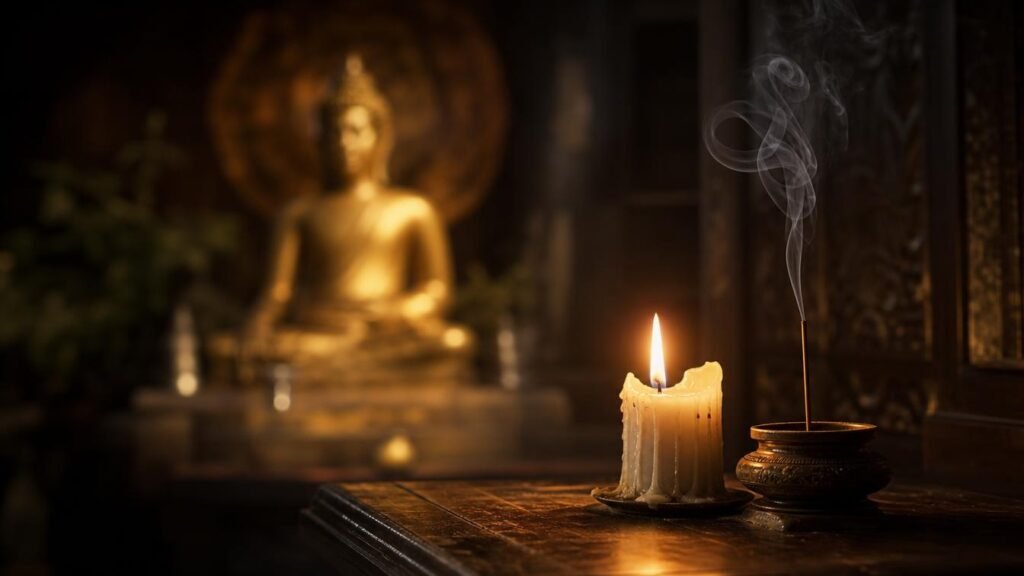
Anicca means that conditioned things do not stay the same. Your body ages, your mood shifts, and a busy day turns into a quiet night. Nothing you can name stays fixed for long. For a closer look, read the Dhammapada 277 teaching on impermanence.
This sounds bleak, but the point is practical. Pain changes too, which means a hard moment will not last forever. This is the first of the three marks of existence, and the easiest one to see.
The Second Mark: Nothing Fully Satisfies
Dukkha is often translated as suffering. Many teachers prefer “unsatisfactoriness,” because the word covers more than big pain. It includes the small itch of wanting things to be different. Even a pleasant moment ends, and that makes it hard to hold onto.
Translations differ here. Müller’s older wording is “grief and pain,” while modern writers often choose softer terms. The meaning is the same: clinging to what changes leads to strain.
If you want the full framework, the four noble truths show how this second mark leads to a way out. Of the three marks of existence, this one is the easiest to feel in daily life.
The Third Mark: There Is No Fixed Self
Anatta means that you cannot find a permanent, unchanging self behind your thoughts and feelings. What you call “me” is a changing mix of body, feeling, perception, habit and awareness. Some scholars note that this third mark has a wider reach than the first two, since it applies to all things and not only to conditioned ones. This is one reading among several, so treat it as a point of study.
This idea is the hardest of the three. You can read a gentler introduction in this guide to non-self. Among the three marks of existence, this one asks the most from a beginner.
How the Three Marks of Existence Work Together
The marks are not three separate problems. They support one another. Because things change, they cannot give lasting satisfaction. Because they cannot be held, there is no fixed owner to hold them.
In other words, seeing one mark clearly often makes the other two easier to see. That is why the Dhammapada places them side by side.
A Simple Way to Notice the Three Marks of Existence Today
You do not need to accept any of this on faith. Try a small test for one day.
- Pick one passing feeling, such as boredom, joy or irritation.
- Watch it for one minute and notice that it changes (anicca).
- Notice whether you wanted it to stay or go, and what that wanting felt like (dukkha).
- Ask who is watching, and see whether you can find a fixed “someone” there (anatta).
If this brings up strong fear or distress, stop and speak with a trusted teacher or a mental health professional.
Final Thoughts on the Three Marks of Existence
The three marks of existence are not meant to make life look grim. They are meant to describe how things work, so you can stop fighting it. Start with the first mark, since change is the easiest to see, and let the other two follow in their own time.