Perfectionism Buddhism has a simple answer for this feeling: you finish something. And instead of feeling done, you feel the gap between what it is and what it should have been. The presentation was good – but it could have been better. The conversation went well – but you should have said that one thing differently. The work is complete – but not quite complete enough.
Perfectionism disguises itself as high standards. It feels responsible, even virtuous – as though the relentless inner critic is the only thing standing between you and mediocrity. The Buddha saw through this disguise. And what he identified underneath it is worth sitting with.
“The Middle Way avoids both extremes – extreme indulgence and extreme self-mortification. Both lead away from the path. The Middle Way leads to vision, knowledge, and liberation.”
– Buddha, Dhammacakkappavattana Sutta (SN 56.11, Pali Canon)
Perfectionism Buddhism: What It Actually Is
In Buddhist psychology, perfectionism is a form of tanha – craving – specifically, craving for a version of reality that does not match what is actually here. The perfectionist mind does not accept the work as it is. It holds it against an imagined standard that moves further away the closer you get to it.
This is upadana – clinging – applied to achievement and identity. The perfectionist clings not just to an outcome, but to a self-image: the person who does not make mistakes, who is not found lacking, who cannot be criticized because nothing less than flawless has been released.
Perfectionism is not the pursuit of excellence. It is the avoidance of the feeling that comes with imperfection – the shame, the self-criticism, the exposure of not being enough. It is, at its root, fear wearing the costume of standards.
The Buddha’s Own Path Beyond Perfectionism
Before his enlightenment, the Buddha spent years in extreme asceticism – fasting until he was skeletal, holding his breath until he collapsed, exposing himself to pain as a spiritual discipline. He was, in a sense, a perfectionist about spiritual practice itself: if suffering led to liberation, then maximum suffering should produce maximum liberation.
It produced near-death. Nothing else.
When he finally accepted a bowl of rice – ending years of self-mortification – his fellow ascetics left him in disgust, convinced he had given up. What he had actually done was discover something more important than any extreme: the practice of enough. Not the practice of perfect. Not the practice of maximum. The practice of sustainable, calibrated, genuine effort – without the self-punishment that makes it impossible to continue.
The Middle Way was not a compromise. It was the actual path – the one that worked, precisely because it did not demand the impossible.
The Cost of Perfectionism No One Talks About
The obvious cost of perfectionism is exhaustion – the same burnout that comes from a lute string pulled too tight, as we explored in the Sona Sutta. But there is a subtler cost that the Buddhist teaching points to.
Perfectionism prevents completion. The work that is never quite done enough is the work that never gets released, shared, or used. The relationship that needs to be perfect before it can be invested in is the relationship that never deepens. The life that needs to be arranged correctly before it can be lived is the life that is perpetually deferred.
The Buddha taught that impermanence means nothing stays exactly as it is – including the imperfect work, the imperfect self, the imperfect situation you are standing in. Everything is already changing. Waiting for perfection means waiting for something that, by definition, cannot arrive.
“Better it is to live one day seeing the rise and fall of things than to live a hundred years without ever seeing the rise and fall of things.”
– Buddha, Dhammapada verse 113
Kintsugi – The Buddhist Aesthetic of Broken and Repaired
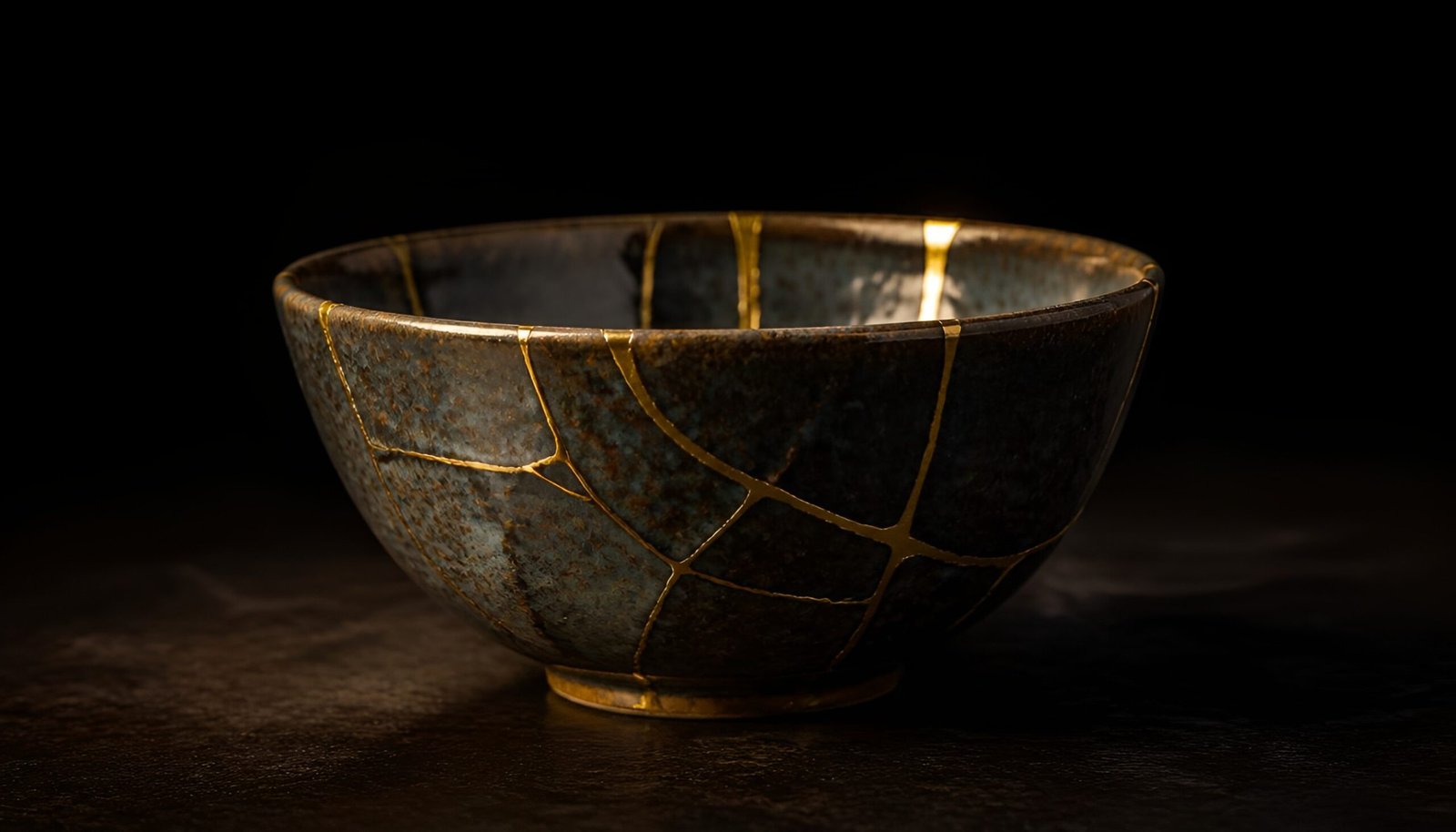
There is a Japanese art form called kintsugi – “golden joinery” – in which broken pottery is repaired with gold lacquer, making the cracks visible rather than hiding them. The repaired object is considered more beautiful than the unbroken one, not despite the breaks, but because of them.
This aesthetic comes directly from the Buddhist understanding of impermanence and the value of what has been through difficulty. A flawless surface that has never broken tells one story. A surface that cracked, was repaired with care, and continued to hold tells a more interesting and more honest one.
Perfectionism demands the unbroken surface. The Buddhist path suggests that the gold in the cracks is more valuable than the pretense of having none.
How to Practice the Middle Way with Perfectionism
Perfectionism Buddhism isn’t just diagnosis – here’s what to actually do with it.
- Notice the inner critic’s voice. The perfectionist inner voice is not the voice of high standards – it is the voice of fear. Notice when it speaks. “This isn’t good enough” – good enough for what? For whom? The standard is worth examining before accepting.
- Practice completing things. Done and imperfect is more honest than perfect and deferred. The Buddha did not wait until his teaching was perfect before he shared it – he taught from where he was, with what he understood, and refined it across forty-five years. Release the work. Let it be what it is.
- Separate effort from outcome. Right effort – samma vayama – is about the quality of your engagement, not the perfection of your result. You can give your genuine best without requiring the result to match a standard that lives only in your imagination.
- Apply self-compassion as a practice, not a platitude. The metta practice begins with yourself: May I be happy. May I be well. May I be free from suffering. The perfectionist mind excludes itself from this. Deliberately including yourself – especially in moments of falling short – is one of the most direct ways to loosen perfectionism’s grip.
- Look for the gold in the cracks. Every mistake, every failure, every imperfection you have moved through has left something behind – knowledge, resilience, humility, a deeper understanding of what you are actually capable of. These are not things a flawless record could have given you. They are the gold in the lacquer.
This is the core of perfectionism Buddhism: the Middle Way was not found by doing everything perfectly. It was found by doing something real, and being honest about what it produced, and adjusting, and continuing. That is still the path.
You are not a flaw to be corrected. You are a practice in progress. 🙏
Source: Dhammacakkappavattana Sutta, SN 56.11 · Dhammapada verse 113 · Tanha · Upadana · Pali Canon
Tags: perfectionism buddhism · buddha middle way perfectionism · why perfectionism is suffering · buddhist teaching on perfectionism · kintsugi buddhism · how to let go of perfectionism · self compassion buddhist
🙏 More teachings from the Buddha
Subscribe to Peaceful Buddha for short daily teachings. Visit Peaceful Buddha on YouTube