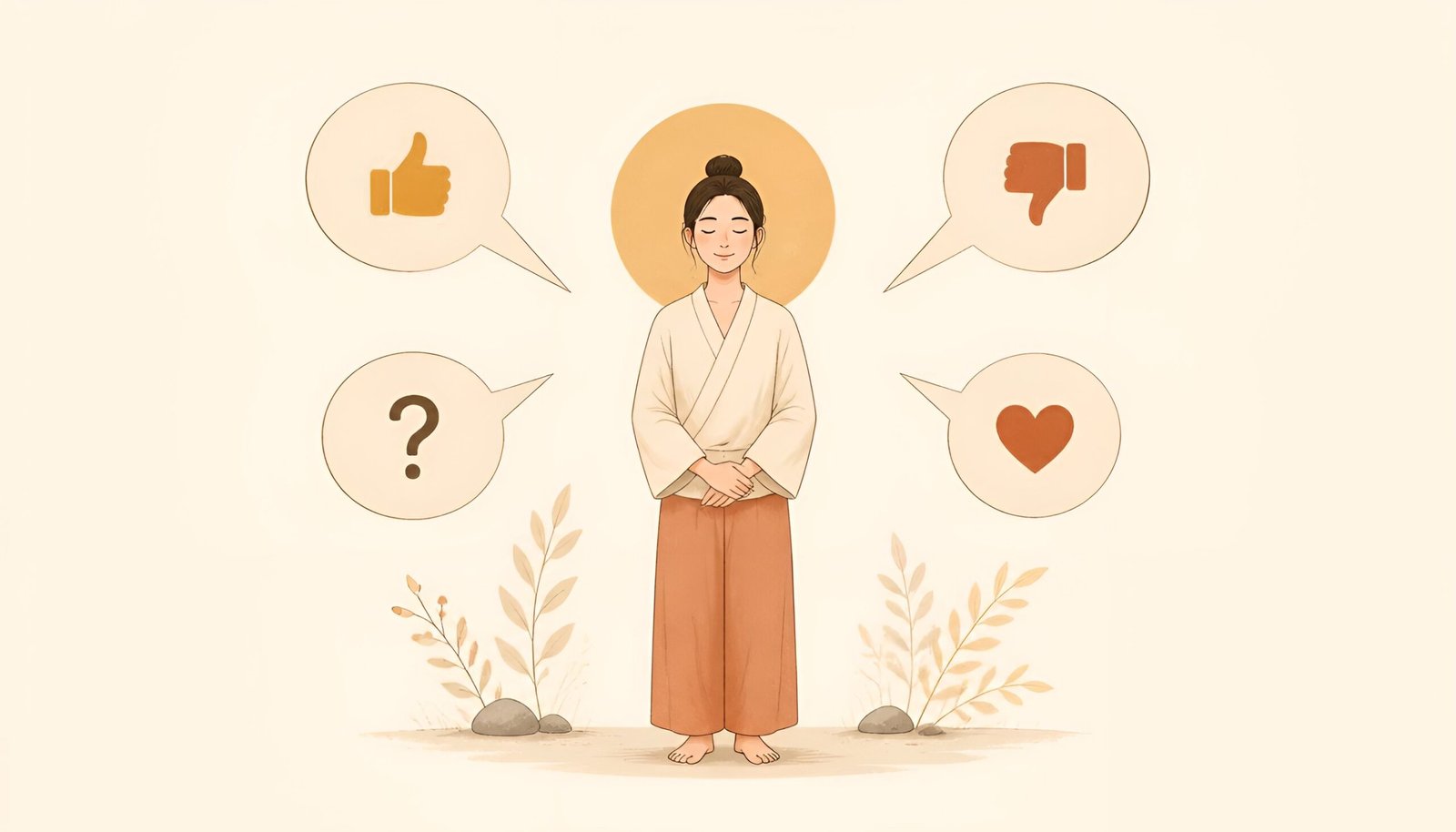
No one escapes blame – not your favorite teacher, not your favorite leader, not even the Buddha. Someone compliments your work, and you feel ten feet tall for the rest of the day. Someone criticizes it, and the same day collapses into self-doubt. Your mood, your sense of worth, your entire emotional weather system – swinging based entirely on what someone else just said.
The Buddha had an answer for this – and it starts with a fact most people never quite accept: you cannot win.
“They blame one who is silent, they blame one who speaks much, they blame one who speaks little. There is no one in this world who is not blamed.”
– Buddha, Dhammapada verse 227
The True Story Behind This Teaching
This verse was not spoken in the abstract. It came from a real situation, recorded in the commentary tradition that accompanies the Dhammapada.
A lay disciple named Atula traveled to a monastery with five hundred companions to hear the Dhamma taught. First they approached the elder Revata, known for delighting in solitude – but he said almost nothing to them, and they left dissatisfied, calling him unhelpful.
Next they went to the elder Sariputta, who taught them the Abhidhamma in exhaustive, precise detail. This time they complained he had gone on far too long and made it too complicated.
Finally they approached the elder Ananda, who gave them a brief, essentials-only teaching. And still they were not satisfied – this time complaining that he had said too little.
Three different teachers, three completely different approaches, and the same group of people found something to criticize in every one. When the Buddha heard about this, he did not tell them to try a fourth teacher. He told them the truth: there is no one in this world who escapes blame.
Why Praise and Blame Have So Much Power Over Us
The Buddha identified praise and blame as two of the eight loka dhamma – worldly vicissitudes, the natural ups and downs that every human life encounters. Alongside gain and loss, pleasure and pain, fame and disrepute, praise and blame form a pair that most people spend their entire lives being tossed between.
The reason these have such power over us is simple: most of us have outsourced our sense of worth. We have made our internal experience dependent on external verdicts – what someone says, how they react, whether they approve. When your sense of okay-ness lives in someone else’s opinion, you are never actually steady. You are only ever as stable as the last thing someone said about you.
No One Escapes Blame – Not Even the Wisest Teachers
Atula’s story is almost comic – three teachers, three opposite styles, three complaints. But it reveals something most people never admit to themselves: there is no version of you, no amount of adjusting your tone, your output, your personality, that will satisfy everyone.
The person trying to please every critic is chasing something that has never existed and will never exist – universal approval. Verse 228 makes this explicit: there has never been, and never will be, anyone who is always blamed or always praised. Not the Buddha himself.
This is not a reason for despair. It is a release. If universal approval was never available to begin with, you are not failing to achieve it. You were simply chasing something that was never on offer.
“The wise show no elation or depression when touched by happiness or sorrow.”
– Buddha, Dhammapada verse 83
How to Build This Kind of Stability
Once you accept that no one escapes blame, the question shifts from “how do I avoid criticism” to “how do I stay steady inside it.”
- Notice the swing as it happens. The next time praise lifts you or criticism deflates you, simply notice the movement. “My mood just shifted because of what they said.” Naming it creates the smallest amount of distance – and that distance is where the practice begins.
- Separate the feedback from your worth. Someone’s opinion of your work, your choices, or your character is information – sometimes useful, sometimes not. It is not a verdict on your fundamental value.
- Stop optimizing for universal approval. Atula tried three completely different teachers looking for one no one would criticize. It does not exist. The moment you accept this, you can stop adjusting yourself endlessly to chase something unreachable.
- Receive praise without needing it. It is fine to enjoy kind words. The practice is not refusing them – it is not needing them in order to feel whole.
- Receive criticism without needing to defend. Some criticism is accurate and worth learning from. Some is simply someone else’s projection. Either way, you do not have to win an internal argument against it to remain steady.
Atula never found a teacher no one could criticize. No one ever will, because that teacher does not exist.
If this idea of inner steadiness under pressure resonates, our guide on the Buddha’s teaching on self-mastery explores the same territory from a different angle.
You were never meant to please everyone. Let that go. 🙏
Source: Dhammapada verses 227, 228, 83 · Atula Upasaka Vatthu · Pali Canon
Tags: no one escapes blame buddha · dhammapada verse 227 · buddha teaching on praise and blame · equanimity buddhism · atula lay disciple story · how to not be affected by criticism buddhist
🙏 Enjoyed this teaching?
Watch the short video version and subscribe for daily Buddhist wisdom. Visit Peaceful Buddha on YouTube